While I'm waiting for the anagama kiln to cool, check this link out on Pete Pinnell's take on cups. As an artist who works primarily but not exclusively in clay, I create simultaneously in functional pottery and sculpture. Sculpture satisfies one need but being able to make something that you can also use, is also gratifying. Anyway, Pete discusses the continuum of art, craft, aesthetics, and experience in a simple everyday functional piece of work that we all use in one form or another.

I'm a potter and artist from the NYC area living in rural Eastern Kentucky. I swear a lot.
Monday, November 14, 2011


Saturday, November 12, 2011
Anagama: Last shift
 |
| 8 am Saturday morning. |
 |
| Bill Lennox, Joe Molinaro of EKU and Seth Green of Morehead State University consult the final push. |
 |
| Working hard |
 |
| Stoking to drop cone 11 |
 |
| Cone 11 dropped. |
Friday, November 11, 2011
Anagama: Day 2 firing
 |
| Overnight shift |
 |
| Mmmm... red...firey... |
 |
| Evening crew, students from Morehead and Shift Boss Bill |
 |
| Sunrise on the new shift crew |
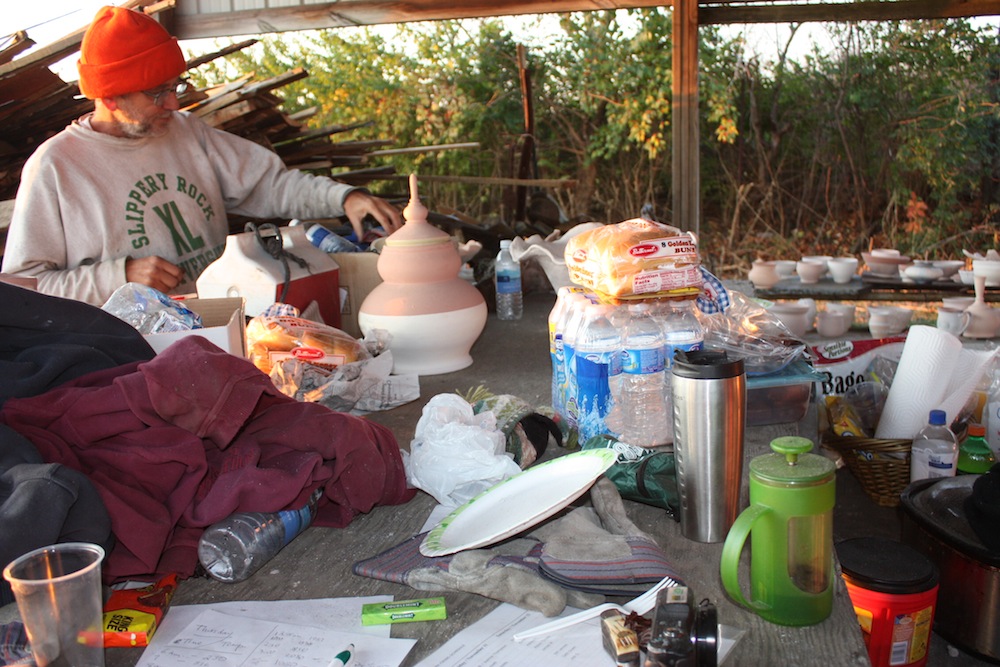 |
| Always food. Always. Always full of ash. Always. |
 |
| Jeff Enge of Tater Knob Pottery contemplating his next move. |
 |
| Stoke that flame! |
 |
| We drifted from here to a little above 2200°F according to the pyrometer |
 |
| Overlapping shift crews. It was cold in the am and only in the mid 40's by midday. Barely noticeable with a raging kiln in front of you. |
 |
| New crew at the beginning of the shift. Aw! Look how clean and bright-eyed! |
Thursday, November 10, 2011
Anagama: First morning firing
My shift at 6am this morning took the kiln from the initial campfire to jumping the fire in to the firebox. We started at approximately 217°F and went up at a rate of 100°F an hour. By the time we handed over the shift, we were at 800°F and climbing and just heading in to quartz inversion. Minimal raking was done as we were mostly just trying to climb. The shift after us promised much raking of an established coal bed and continued climbing of temperature at 100°F an hour. More pix tomorrow. The fire should be much more intense which will be welcome as the overnight low is expected to be in the 20's to low 30's. In addition to the stoking, an overflow coal bed should be established outside the kiln area and breakfast will be cooked!
 |
| Moonset |
 |
| Soot on pots. About 500°F |
 |
| Fire is chugging right along! |
 |
| Shift change! |
 |
| Large stoke before heavy first raking. |
Anagama: loading Day 2
 |
| Mid-kiln |
 |
| Mid-kiln |
 |
| Putting in the pyrometer to keep track of the temperature changes |
 |
| Towards the front of the kiln |
 |
| Front finished |
 |
| Standing in the firebox |
 |
| Flue slurry |
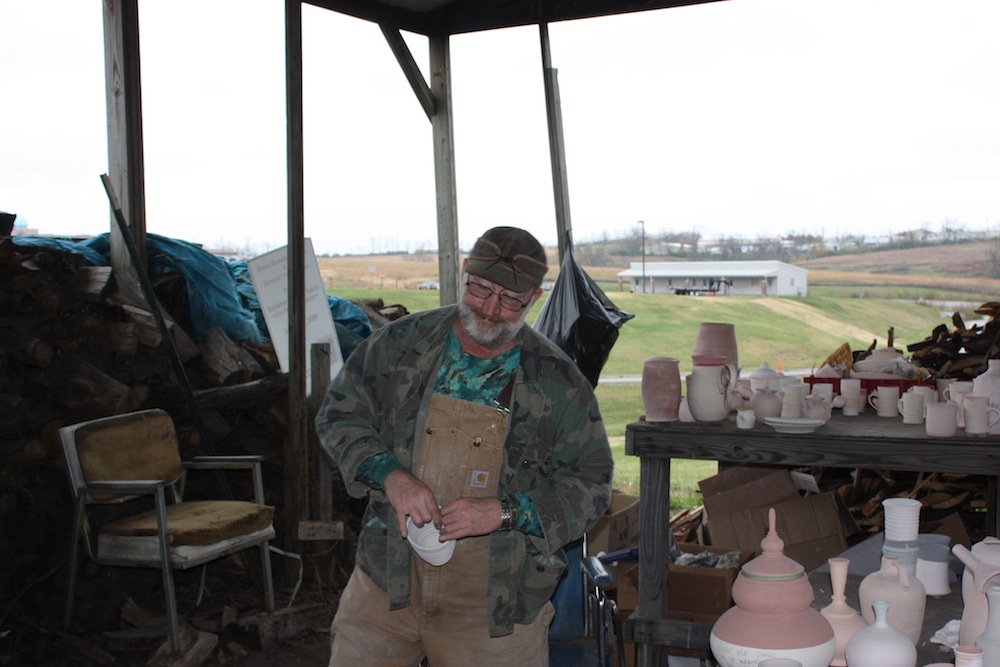 |
| The man who starts the fire. |
Anagama: loading day 1
Eastern Kentucky University operates an anagama kiln on campus. 1-2 times a year, they try to fire it. The firings take about 3-4 days and often include a diverse crew made up of students from EKU and other nearby universities plus area ceramic artists and potters. Much food is eaten. Join the EKU Ceramics group on Facebook for updates on EKU Ceramic happenings.
 |
| The anagama kiln at EKU |
 |
| Pots ready for wadding |
 |
| Some Richard Burkett and EKU student pots |
 |
| Additional shelves. Lots to choose from. Better to have too many, than too few. |
 |
| Pots, people and the woodpiles |
 |
| A real communal effort |
 |
| What kiln loading usually looks like. Cramped spaces, dusty, dirty and ass-end first. |
 |
| Placement of pots at the rear of the kiln |
 |
| Careful wadding... |
Tuesday, November 8, 2011
Potterypalooza!

If you find yourself in Richmond, Kentucky, stop by Irvinton House Museum. Several of us area potters and ceramic artists are setting up in the bottom floor of this 19th century house to hawk our wares. Not only are these things hand made, they're hand made in the USA.
Subscribe to:
Posts (Atom)